Continued lack of consensus at next meeting could cast shadow on GST rollout by April 1.

As per the revised return filing timeline decided by the Council, for July, the sale returns will have to be filed by September 5 instead of August 10. Companies will have to file sale invoice for August with the GST Network by September 20 instead of September 10 earlier.

'There are unscrupulous traders who create fake invoices by showing bogus e-way bills, movement of goods.' 'Since the entities registered across different states, and kept on changing their numbers, tracing them was difficult.'

'We are not opposed to any Indian language. We are against Hindi imposition.'

The opposition parties vehemently criticised the new 'one nation, one tax' system having four different rates instead of a single rate adopted in some countries including the UK and Singapore.

All goods and services have been put in slabs of 5%, 12%, 18% and 28%

With the reality of coalition politics staring the BJP in its face, this was inevitable, points out Ramesh Menon.
Finance Minister Nirmala Sitharaman on Thursday said taxpayer base has almost doubled to 1.28 crore in four years of rollout of the historic tax reform and the enhanced GST mop up in the recent months should now be the "new normal". In a written message to tax officers on the fourth anniversary of GST rollout, she said implementing any reform of this scale in a large and diverse country like India can be highly challenging, but GST has brought about ease in taxpayer compliance and reduced common man's tax burden.

FBT was an unpopular tax and withdrawn before the General Elections in 2009

Amid record-high fuel prices, Finance Minister Nirmala Sitharaman on Monday said there is no proposal as of now to bring crude oil, petrol, diesel, jet fuel (ATF) and natural gas under the Goods and Services Tax (GST). When the GST was introduced on July 1, 2017, amalgamating over a dozen central and state levies, five commodities - crude oil, natural gas, petrol, diesel, and aviation turbine fuel (ATF) - were kept out of its purview given the revenue dependence of the central and state governments on this sector. This meant that the central government continued to levy excise duty on them while state governments charged VAT. These taxes, with excise duty, in particular, have been raised periodically.

Hindi film industry hopes to get some tax relief from the upcoming Budget 2015-16.

With exporters' claim for over five months still pending, liquidity has been wiped out and the process of finalising new contracts has been held up.

He also took potshots at opposition parties' decision to observing November 8 as a 'Black Day', saying the move displays their faith in cash economy.

The government has already embarked on strengthening the tax net by sending letters to those who have not filed tax returns.

Online skill-based gaming industry has made a case for retaining the service under 18 per cent GST slab instead of putting it into the highest 28 per cent tax rate category, saying the move will badly hit the $2.2-billion sector. The increase in taxation would not only have catastrophic impact on the industry but also encourage offshore operators who would circumvent Indian tax jurisdiction by hosting games in some other country, Games24x7 Co-CEO Trivikraman Thampy said. "It would be a triple whammy -- the industry loses out, the government loses out on tax revenue and players loses out as they would be exposed to unscrupulous operators," he said.

GST will make it easier for governments to spend more, says T C A Srinivasa Raghavan.
No longer a discretion of the tax administrator, the audit of returns filed by taxpayers is now based on a selection by algorithms, notes Tarun Bajaj.

If the product is genuine, denial is violation of consumer laws.

The prime minister is aware that whatever be its consequences, a new taxation regime cannot be launched closer to the general elections in 2019. Thus, any date after April 2017 for the launch of GST is risky, says A K Bhattacharya.

It's an undeniable fact that after enactment of GST, buying insurance will become a little expensive impacting your term plans, health plans and motor insurance plans the most. But you should not ignore the importance of insuring your life, health, vehicle, says Harjot Singh Narula
Manufacturing taxes, VAT will come down, assures Jaitley

FinMin does not expect tax or non-tax revenue to reach anywhere close to the targets set in the interim Budget. Sources say that the challenge before the new government will be either to accept the reduced projection and tailor the Budget accordingly or set a more ambitious target.

A 5 per cent GST rate kicked in on Monday on pre-packed and labelled food items such as cereals, pulses and flour weighing less than 25 kg.
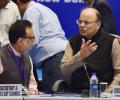
Cap on bank withdrawals to be reviewed after Dec 30, says finance secy.

Drabu said the GST regime will roll out in the state at midnight on Friday, making Jammu and Kashmir the last state to join the new tax regime.
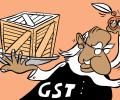
If other states follow suit, it is going to become difficult for the GST Council to decide on the next stage of reforms.
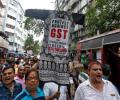
After 17 tumultuous years, a nationwide Goods and Services Tax (GST) will rollout from midnight of June 30, overhauling India's convoluted indirect taxation system and unifying the $2 trillion economy with 1.3 billion people into a single market.

Electricity has also been kept out of the GST ambit.
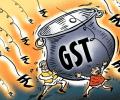
Rationalisation of rates will be taken up for smaller items that do not have major revenue implications but are commonly consumed at the GST Council meet on Saturday

http://im.rediff.com/money/2023/jul/20uv.jpg

The passage of the bill will pave the way for setting up of a GST council that will decide the tax rate, cess and surcharges.

Experts share their views on the steps that will help businesses become GST-ready.

The consensus was reached after the Centre agreed to the demand of states to go in for horizontal split

The new tax rates will come into effect from January 1, 2019.

Total number of GSTR-3B returns filed up to January 30, 2022 is 1.05 crore that includes 36 lakh quarterly returns, the finance ministry said. January is the fourth straight month when Goods and Services Tax collection has crossed Rs 1.30 lakh crore.

The mop-up could have been much higher, but tax on imports fell 2 per cent y-o-y.

He also said GST will take about a year to stabilise.

Prime Minister Narendra Modi and chief ministers of states may soon have an in-person interaction on a common platform for the first time since 2019. The seventh meeting of the Governing Council of NITI Aayog is likely to be held in late June or early July, Business Standard has learnt from sources in the Centre and a state. While the date and other details are yet to be finalised, it is learnt that there will be a conclave of chief secretaries of states and Union Territories in Dharamshala, Himachal Pradesh, on June 14 and 15, which will decide the agenda of the Council meeting to be held at a later date.

Its officers would wear black bands on Monday, which is also Martyrs day, the IRS Association (Customs and Central Excise) has said.

Measures may include tax slab and rate revisions for individuals, companies.
